Pages

Friday, July 24, 2026

小真的六度波羅密{HD}

故事簡介   

剛上國中的小真沒有前排牙齒,開學第一天就被同學嘲笑。小真的生活簡直一團糟,沒有媽媽,爸爸入獄,功課差,沒有朋友,在學校不敢和同學說話,回到家老是被阿嬤罵!而妹妹小美每次都考第一名,長的漂亮又被阿嬤寵愛,像小公主......為什麼人生這麼不公平?小真覺得自己好倒楣。   終於有一天好運降臨,老師要小真參加全國繪畫比賽。「如果得到第一名,就有獎金可以裝假牙!我就能擺脫悲慘的命運!」小真的美夢被阿嬤阻止,要求她考試第一名才能參加比賽,這對小真來說難如登天。   這時,山上德化寺的德師父給了小真一本《六度集經》,沒想到這本神奇的書卻改變了小真的人生...   小真意外進入了書中的奇幻世界,遇見神龜、象王、毒蛇、蜜蜂王,展開了一段又一段奇異的書中旅程,她開始發現這個世界並不是她想的那樣...


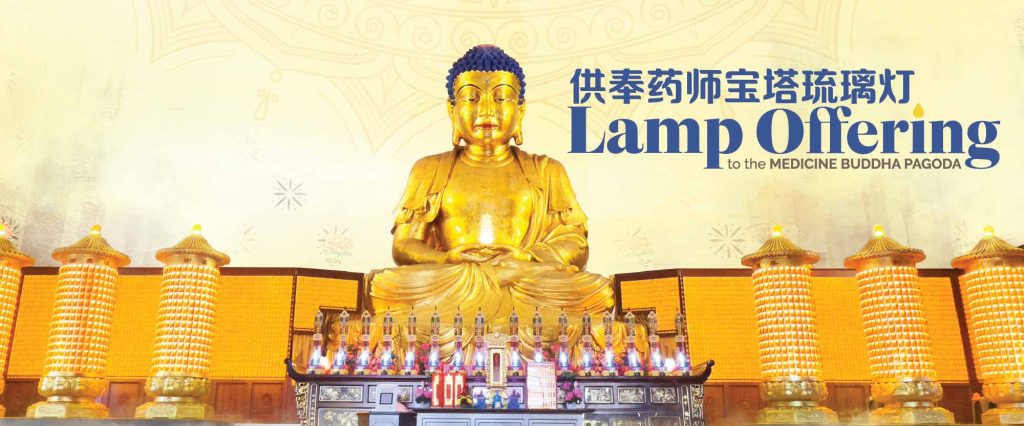
Lamp Offering to the Medicine Buddha Pagoda 供奉药师宝塔琉璃灯


According to the Medicine Buddha Sutra, making offerings to the image of the Medicine Buddha generates vast merits, promotes healing of body and mind, purifies negative karma, removes obstacles, and supports the fulfilment of wholesome aspirations.

Each turn of the revolving pagoda represents a turning of the Dharma wheel, radiating light and blessings in all directions. Whether the offering is made for yourself, your loved ones, or those in need, it is a meaningful way to bring peace and benefit to many.

Let us come together in reverence to the Medicine Buddha and illuminate the world with healing light.

根据《药师如来本愿功德经》,虔诚供奉药师佛,可得无量功德、身心疾患得愈、业障悉皆清净、违缘障碍消除、善愿悉皆成就。

转经塔每转动一周,犹如转动一次法轮,将药师佛的琉璃光明遍照十方,利益无量众生。无论您是为自身、亲友或一切病苦众生发心供养,皆是广行大悲,成就自他解脱的殊胜资粮。

同礼药师如来,为人间广布清凉与希望,遍洒疗癒之光。


As offerings are limited, it is advisable to register promptly following the principle of first come, first served.
由于数量有限,欲供奉者请尽早。

Sponsorship Period 供奉期限:
From 1 May of the current year to 30 April of the following year
从每年的5月1日至隔年的4月30日

Venue 地点:
Pagoda of 10,000 Buddhas | Hall of Medicine Buddha
万佛宝塔 | 药师殿

Sponsorship per statue 每尊圣像供养:
$128

Registration starts 报名日期: 
1 May 2026 (until fully registered)
2026年5月1日起(额满即止)

Online Registration 线上报名
** Online registration commences at 8.30am on 1 May every year and closes when fully registered.
线上报名将从每年的51日早上830分开始接收报名,额满为止。

In-person registration 现场报名:
KMSPKS Front Office 光明山普觉禅寺寺务处

Enquiries 询问:
6849 5333 | g_fo@kmspks.org

https://kmspks.org/news/lamp-offering-to-the-medicine-buddha-pagoda-%e4%be%9b%e5%a5%89%e8%8d%af%e5%b8%88%e5%ae%9d%e5%a1%94%e7%90%89%e7%92%83%e7%81%af/ 


Grate expectations: the troubled quest for tasty vegan chees

The plant-based boom failed to deliver. But there may yet be hope.
 
 
In an office block in south London a chef was trying hard to prove that vegan cheese wasn’t disgusting. Violife, a brand that makes dairy-free products, had asked him to make a multicourse lunch to show off its cheese alternatives. The chef, Duncan Parsonage, served up a fake-meat Cuban sandwich topped with gooey mock mozzarella, tortilla chips with whipped Greek White (a version of feta) and, to top it off, a doughnut filled with imitation cream cheese. It was all tasty enough, but it was clear that the cheese needed dressing up. Even Parsonage confessed the products would struggle to hold their own on a cheese board. As vegans know, ersatz cheese can be waxy and bland—and nowhere near as good as the real thing.
 
I swore off animal products several years ago, when the vegan-food craze was at its peak. Propelled by wellness influencers and Netflix exposés of the meat industry, veganism became aspirational—and lucrative. Venture capital and celebrity finance poured into firms such as Impossible Foods and Beyond Meat, the latter of which boasted Bill Gates and Leonardo DiCaprio among early investors and went public in 2019 at nearly $4bn. In 2021 Oatly, a Swedish oat-milk firm that was backed by Oprah Winfrey, Jay Z and Natalie Portman, was valued at around $13bn. Its chief executive hailed the stars’ investment as “a clear indication of where the world is heading”. Food, like popular culture, was going woke.
 
During the pandemic, however, it became clear that investors had overestimated consumers’ appetite for vegan alternatives. Sales of plant-based meat and milk have since stalled, weighed down by higher prices and growing suspicion of ultra-processed foods. Beyond Meat is now worth less than $400m and Oatly has lost 97% of its peak value. Yet although the companies at the forefront of the vegan-food revolution are worth less, most of their products are still widely available. Fortunately for people like me—and for anyone with a dairy allergy or intolerance—plant-based milk is pretty good. Last year it accounted for 13% of American milk sales, while Square, a payments firm, has said that oat milk is chosen for one in three coffee orders made through its platform. Even cafés in the back of beyond serve oat-milk lattes, and most supermarkets stock several varieties.
 
Propelled by wellness influencers and Netflix exposés of the meat industry, veganism became aspirational—and lucrative
 
But there is one dairy alternative you’re unlikely to spot in shopping trolleys, even if that trolley contains dairy-free ice cream and chocolate. Vegan cheese makes up less than 1% of the American cheese market, and sales were 10% lower at the end of 2025 than a year earlier. Clearly I’m not the only consumer who finds it offputting.
 
Why is vegan cheese still so disappointing? The answer can be found under a microscope. Milk consists of two proteins: whey and casein. Casein is what makes cheese cheesy. Unlike most proteins, it doesn’t form a fixed shape. Instead, it gathers into tiny clusters that trap fat and calcium (these are what makes cheese stretchy when melted). As cheese ages, the clusters slowly break down, releasing enzymes that produce complex flavours. Plant proteins can’t replicate this behaviour: they are more rigid and don’t bind fat and calcium in the same way.
 
Companies like Violife have attempted to sidestep the casein problem by focusing not on what cheese is, but what it does. They generally use coconut oil and tapioca starch to replicate some of cheese’s distinctive properties. Like cheese, coconut oil is solid at room temperature and melts under a grill. Tapioca gives the melted oil its tackiness and stretch (think tapioca balls in bubble tea). Synthetic flavouring and salt are added for the final touch.
 
Parsonage told me vegan cheese is best enjoyed as an ingredient on a burger or pizza. Even then, texture is a problem. Shreds of Violife blocks “lock up” under direct heat in a pizza oven, softening around the edges but refusing to melt. Their fake Camembert comes with instructions: don’t bake it for as long as a real one, or it will turn into liquid rather than a gooey treat.
 
There are other snags. Despite being plant-based, most vegan cheese isn’t very nutritious. It’s high in saturated fat and contains almost no protein. It also doesn’t taste of much, apart from coconut. In theory, any taste can be mimicked with the right combination of synthetic flavours, but recreating the notes of a ripened cheddar is prohibitively expensive.

https://cdn.economistdatateam.com/videos/1843/vegan-cheese/4_1280.mp4 

There is an obvious solution: make casein without a cow. A handful of scientists and entrepreneurs are using a process called precision fermentation to do this. Fermentation is when a microorganism, like bacteria or yeast, breaks down sugars into new compounds. It turns grape juice into wine, cabbage into kimchi, and milk into cheese. Precision fermentation involves genetically modifying that microorganism to make it break down sugars in a specific way. (In the 1980s it was used to make synthetic insulin—previously diabetics had to inject themselves with insulin from animal pancreases.)
 
Last year I visited Wageningen University in the Netherlands, where teams are trying to perfect the method. Scientists there have isolated the DNA sequence in cows that produces casein. They stick it into E. coli bacteria, give the bacteria glucose to feed on, and caseins get left behind. They are then mixed with oil and water to make a kind of mozzarella. “It’s more similar to the animal product,” Julia Kepler, one of the scientists, told me. “Though, of course, we haven’t tasted it yet.”
 
Under European Union (EU) law, precision-fermented cheese is classified as a “novel food” and must receive approval before it can be marketed to consumers—a process that can take years. The EU doesn’t explicitly ban scientists from tasting the food, but most countries take a cautious approach, treating any human consumption as off-limits until approval is granted. (Since my visit, the Dutch government has relaxed its rules and now allows tastings under strict conditions—the first EU country to do so. Researchers in Wageningen hope to organise their first tasting later this year.)
 
Some EU countries are deeply resistant to alternative proteins. The Italian parliament banned lab-grown meat in 2023, in defence of the country’s culinary traditions. The move was pre-emptive: cultivated meat is not yet approved for sale in the EU (it’s also not clear whether the ban would survive a court challenge). But the vote demonstrated strong feelings about what the country’s agriculture minister called “the social and economic risks of synthetic food”.
 
Vegan cheese makes up less than 1% of the American cheese market, and sales were 10% lower at the end of 2025 than a year earlier
 
The work at Wageningen is funded through government grants and partnerships with food companies, which will have to confront the EU’s regulatory hurdles before bringing the lab’s creations to market. Those companies will face another challenge: precision fermentation is expensive, and it’s unlikely cheese created in this way could ever compete on cost with real cheese.
 
For now, though, the researchers are trying only to prove the technology works. They test the physical performance of samples against real cheese, measuring density, melting temperature and stretch length. Kepler insisted she’s never sneaked a bite. Previously, she spent four years working on precision-fermented milk before she was allowed to try some. That was at a conference in America, where regulations are more relaxed. “People are consuming it there,” she said, “and they’ve survived.”
 
It is no surprise that California has become a breeding ground for alternative proteins. Its tech, research and wellness industries are fuelled by abundant venture capital and lack of red tape—at least compared with Europe. Beyond Meat and Impossible Foods both emerged from this ecosystem, alongside a lesser-known company called Climax Foods.
 
Its founder, Oliver Zahn, had been a data scientist at Google, and before that at SpaceX and Impossible Foods. He grew up in Germany and had come to America for postgraduate studies in astrophysics. He wrote influential papers on the origins of the universe and served as director of the Centre of Cosmological Physics at the University of California, Berkeley. But although he enjoyed decoding the mysteries of space, he was increasingly distracted by another problem of cosmic proportions: how to make vegan cheese taste good.

https://cdn.economistdatateam.com/videos/1843/vegan-cheese/2_1280.mp4

I first spoke to him on a video call early last year. He is long and lean, with a shaven head and dark eyebrows. “There was nothing even borderline good as an alternative” for vegans like him, he told me, not to mention the two-thirds of the global population that has some form of lactose intolerance. In 2019 he founded Climax, which he said would fix vegan cheese in the same way he’d approached astrophysics: by making sense of complex data. The following year Zahn left Google to run Climax full time. By then, Beyond Meat had gone public and Zahn wanted in on the plant-based revolution.
 
Climax, which was based in Berkeley, pitched itself as the kind of foodmaker only Silicon Valley could produce. It was a “data-science company innovating the future of food”, according to its website. The company boasted that its scientists would develop plant-based cheeses through “sophisticated machine intelligence tools”, including using artificial intelligence (AI) to predict what would happen when a recipe was tweaked. Climax’s name and logo, in which the “M” and “A” formed mountain peaks, suggested a pinnacle—products “better in every way”, as Zahn liked to say in interviews, than the cheeses they were designed to imitate.
 
Zahn raised $7.5m in seed funding and began recruiting through his industry contacts. He and his new team would do the hard thing first: speciality cheeses. This was a strategy Zahn had picked up from Elon Musk when he worked at SpaceX. Zahn’s inspiration was the Tesla Roadster, a high-end proof of concept that ushered in the mass adoption of electric vehicles. “If you can make the fanciest, most difficult car to get right, do that really well, you can hopefully do all the other things really well,” Zahn told me.
 
Making good on Climax’s promise to leverage machine learning would take time. It would first require a data set, fed with the results of experiments on a wide range of potential ingredients. In the meantime, the priority was making a cheese to show to investors. Zahn’s team set to work on a full slate of varieties, including brie and goat’s cheese. Instead of relying on the usual oil and starch, they built their recipes around seeds and legumes. These ingredients were far more nutritious but they were also expensive—a handful of companies had made nut- and seed-based cheeses, but their products were priced high and hard to find. Zahn, however, was confident his team could perfect the taste first and bring costs down later.
 
Although he enjoyed decoding the mysteries of space, he was increasingly distracted by another problem of cosmic proportions: how to make vegan cheese taste good
 
Soon they had something to show for their efforts: Climax Blue, an imitation wheel of blue cheese. It looked impressive: ripples of mould ran through a creamy base of blended seeds, beans and coconut cream. Zahn spent more and more time on the road, showing off Climax Blue, while his team worked back at the lab in Berkeley. He appeared at food expos and met star chefs, promising “zero-compromise” vegan alternatives. At one point, he flew to London for a private tasting with Paul McCartney, who became an investor. Zahn sent me a photo of himself grinning and grasping hands with the former Beatle next to a table strewn with cheese samples. Zahn loved watching the delight of people who tried his cheese for the first time. “I wish you could have filmed their faces,” he told me.
 
The company was looking for a big cash injection that would allow it to make vegan cheese at scale. At the start of 2022 a tech fund in London promised a $60m investment. Zahn and his team were on a high. “The assumption was that we were all going to explode, like the best of the food tech startups,” one former employee told me. The startup’s staff grew to roughly 50 and Climax poured money into research and development.
 
In a way, blue cheese had been relatively easy to get right; its most important quality, taste, could be replicated using the same mould. The real challenge lay with more popular varieties, like mozzarella, where physical properties, like melt and stretch, were paramount. To get those right, Climax would need to confront the casein problem. They would need to develop a process for modifying a seed protein to make it function like a milk protein, without resorting to costly precision fermentation.

https://cdn.economistdatateam.com/videos/1843/vegan-cheese/3_1280.mp4 

In April 2022 Zahn was in a meeting when he got a text from one of his staff telling him to come to the lab right away. Zahn arrived to see employees shooting video on their phones. One of the scientists had been working on an analogue to mozzarella. He’d accidentally overheated the sample, thinking he was setting the oven temperature in Fahrenheit when it was programmed in Celsius. Under the high heat, his sample did something that, up to that point, had seemed near impossible for food made with plant proteins: it melted and stretched, just like real cheese. Zahn became emotional. “We knew immediately we had hit jackpot.”
 
Climax had cracked it. They called the ingredient Caseed. It would not only make a stretchier cheese, but one higher in protein than existing vegan cheeses. The process needed fine-tuning and was expensive. But with the promised cash from the London fund they would surely have enough runway to figure it out.
 
By the middle of 2022, however, the heyday for plant-based foods appeared to be ending. Over the previous year, Beyond Meat had lost nearly 85% of its value. Investors had been treating food like it was software, which can be scaled and sold with the click of a button. But increasing supply of a food product means building more production capacity, and margins were slim, especially given the need to compete with meat and dairy on cost.
 
The London fund pulled out. Despite the setback, things appeared to be going well for Climax. The public got their first tastes of Climax Blue at pop-up events in December 2022. By the end of the following year, more than 15 restaurants, among them the renowned Atelier Crenn in San Francisco and Eleven Madison Park in New York, had included the product in their dishes. Zahn continued to pull together enough money from a group of small investors to keep the company going. In April 2023 Bel Group, the French makers of Babybel and Boursin, announced that it would be working with Climax to make new vegan versions of its products using Caseed. A joint press release talked of “leveraging the power of data science and artificial intelligence” to create “nutritious and affordable” cheeses that would be “indistinguishable from their dairy counterparts”.
 
The following April staff at Climax were excited to hear the company had reached the finals of a prestigious competition, the Good Food Awards. Their cheese would be competing against dairy cheeses in a blind taste test. According to Zahn, the competition organisers emailed Climax to say it had won. But before the awards ceremony, Climax was disqualified. Someone had complained that its cheese included kokum butter, which isn’t on the Food and Drug Administration’s list of foods “generally regarded as safe”. Kokum butter is better known as an ingredient in skincare products, but it is edible, if high in fat, and is sometimes used in Indian cooking. At the time, Zahn claimed sabotage by an “informant” dairy producer. “At the very least,” he told me when I asked him about the late-stage disqualification, “it’s incredibly unprofessional of them.”
 
Climax, which was based in Berkeley, pitched itself as the kind of foodmaker only Silicon Valley could produce. It was a “data-science company innovating the future of food”
 
Behind the scenes, the company was struggling to raise money and was laying off staff. By the end of the year, Climax was down to a handful of employees. The roll-out of Bel products using Caseed, which was promised for the end of 2024, never happened. I spoke to some former employees who told me that even as financing dwindled, it felt like Zahn was trying to do too many things at once. Priorities seemed to shift week to week, based on the latest advice from some adviser or star chef. One former staffer said the team was in a “civil war” about which direction to pursue. Fine cheeses, such as Blue, had impressed investors. But crowd-pleasers such as mozzarella were more likely to sustain the business. Back when raising money was easier, making several products felt more feasible. Another former employee said it seemed like Zahn was waiting for a “white knight” investor that would allow Climax to continue doing everything at once.
 
There was still some interest from investors. In October a fund called S2G Ventures led a $6.5m round, but with one condition: that Zahn step down as chief executive. As the market for plant-based foods shrank, investors wanted someone focused on making products cheaply and efficiently—rather than a brilliant inventor. Sandeep Patel, a former investment banker who’d been advising Climax, would become CEO, with Zahn shifting to a less business-facing role.
 
The company rebranded. Climax Foods would now be known as Bettani Farms. Bettani evoked bucolic Italian pastures and was, said Patel, a riff on Zahn’s boast that their cheeses would be “better in every way”. When I spoke to Patel over a video call in October I asked him why the name had changed. “I think you can answer that question yourself,” he said. When pressed, he admitted he thought the name sounded too sexual. “We’ve been at conferences where people come up to us and say, ‘What are you working on, a Viagra replacement?’” They’d also consulted a branding expert who told them that Climax was a tech-forward name that might have appealed to early investors, but meant little to shoppers. People didn’t want to eat food served by someone in a lab coat, said Patel. They want food served by Martha Stewart.

https://cdn.economistdatateam.com/videos/1843/vegan-cheese/5_1280.mp4

The firm decided to stop production of Climax Blue and focus on more popular cheeses such as feta and mozzarella. In a press release Patel promised to “do for pizza what oat milk has done for coffee”. When I spoke to him in October, Patel criticised “an inordinate amount of focus on a very small area of the market” at Climax.
 
Gone were any mention of data science or AI, which had seemed so important to partners like Bel. Patel wouldn’t discuss how central AI had been to the work at Climax. Former employees told me the issue had caused some internal dispute, after journalists overstated the company’s use of the technology following conversations with Zahn (Zahn denies any misrepresentation on his part). In any case, Bettani Farms was now emphasising its “naturally derived” ingredients.
 
Eventually Zahn left the company completely. “I’m not at liberty to discuss,” Patel said when I asked him why Zahn had left, “but it just wasn’t the right fit.” He said the press—no offence—was too focused on the idea of a hero entrepreneur. “It’s too much reliance, too much belief, that one person is the saviour.” Innovation is ultimately a team effort, he added. And even then, “just because something is a great idea and a great product, doesn’t necessarily make it a great business,” Patel said.
 
“You have to have a compromise,” said Alex, a Climax employee who didn’t want to give their real name. “I think [Zahn] never understood that.” Alex suggested the company could have gone all-in on blue cheese, contenting itself with being a small company for a small market. Another former employee said the team grew overconfident when financing was easy, and tried to do too many things at once. “I look back on it as a missed opportunity,” they said. In an alternate reality, “we would have this mozzarella cheese in Domino’s right about now.” Both agreed an element of hubris was involved. “They all thought they would be the kings of the world,” said Alex, “and it just never happened.”
 
Last summer Zahn was on a cycling holiday in the Bavarian Alps with his son when he flipped over his handlebars and landed on his head. He fractured vertebrae in his neck but mercifully avoided paralysis. When I spoke to him again in October he said he was focused on getting better and planning his next steps, including a new AI-related venture. He wouldn’t tell me anything about it, only that it will enable “humans and AI to discover together”. He was reluctant to talk about his departure from Climax. But he maintained that his original strategy, the Tesla Roadster approach, was the right one. “It was always about mass market,” he said. He’s annoyed at recent statements from Bettani that suggest otherwise, and he insisted that most resources had already been shifted to mozzarella before he stepped down as chief executive.
 
People didn’t want to eat food served by someone in a lab coat, said Patel. They want food served by Martha Stewart
 
Vegan cheese, meanwhile, is still waiting for its oat-milk moment. Cost remains the biggest hurdle for companies experimenting with artificial casein. Caseed’s patent was approved last year, but it is still expensive to make, so using it as a substitute for milk protein would be challenging. One workaround, according to a former Climax employee I spoke to, may be to use small amounts of Caseed to give an edge to conventional oil-and-starch formulations.
 
It’s hard to escape the feeling that vegan cheese was marooned after the plant-based food boom of the 2010s: capital was pouring in, but the problem of how to make it affordable and delicious remained stubbornly unsolved. Now, with funding harder to secure, that prospect looks even more unlikely. You could argue that it offers a parable for the AI bubble today. If the hardest technical problems, such as artificial general intelligence, prove more challenging than investors expect, then they too could be stranded if the bubble bursts.
 
Before I left the Wageningen campus in the Netherlands, the lab team invited me to see its not-quite-mozzarella for myself. They popped a few pieces out of a silicon ice-cube tray and onto a table. It’s off-white, lightly shiny. I picked it up, and it started to soften between my fingers. It didn’t really smell of anything, but it felt decidedly squishy, just as mozzarella should.
 
Sam Colbert produces podcast series at The Economist

What’s your beef? An ethicist’s guide to giving up meat

Why Kant would tell us to skip the salami


By Arianne Shahvisi

The case for giving up meat should be easy to win. Eating meat is clearly inconsiderate to animals: slaughtering billions of sentient beings each year seems gratuitously cruel when our nutritional needs can easily be met in other ways. It’s demonstrably unfair to our fellow humans and the environment, too. Meat-eating – especially consuming beef, which is the most wasteful and environmentally damaging kind – is responsible for most of the carbon emissions the food industry produces.

Yet those who eat meat are largely unmoved by the arguments against it. Why? In most societies, meat-eating is still presented as the natural state of things, a necessary part of a healthy diet. It doesn’t matter that red and processed meats have been linked to cancer and heart disease, or that we know early humans mostly ate vegetables. For thousands of years, meat-eating has been not only normal, but aspirational. History shows that the richer people get, the more meat they crave: when people in poorer countries with traditionally plant-based diets become wealthier, their meat consumption tends to rise. It’s hard to accept that something is morally troubling when so many people around you are doing it.

Some thoughtful meat-eaters argue that there’s no point ditching the drumsticks because the sheer scale of the meat industry renders any individual action futile. They have a point. I’ve been vegetarian for more than two decades, but this has changed next to nothing. Any animals I may have spared have been gobbled up many times over by other people, as global meat consumption continues to rise. For every animal I’ve abstained from eating, some people really have eaten three.

Why bother making an individual sacrifice if the world scarcely notices your good deed? You could argue that this just lets the real villains off the hook. After all, it was the fossil-fuel industry that cooked up the idea of personal carbon-footprint calculators, a notion that left us feeling guilty about our actions as consumers, even as oil companies dodged their far greater responsibilities.


It’s true that various systemic changes could help stop the meat industry destroying the planet. If meat packaging displayed how much rainforest had been felled to graze each cow, guilt might put off some shoppers. Slashing subsidies to livestock farmers and putting a carbon tax on meat would raise the price of your sausages or Sunday roast, and so ration demand.

Yet calling a problem “structural” – even if it is – invites us to wash our hands of it. Racism is structural, too, but individuals still have an obligation not to be racist. Responsibility can lie both with an individual and the system at the same time.

When considering the significance of your own individual actions it’s useful to borrow an idea from Immanuel Kant, an 18th-century philosopher. He devised a simple principle for doing the right thing: “the categorical imperative”.

According to this principle, you should do things only if it would be fine if everyone did so. If scaling up your actions would be untenable, those actions are probably immoral. Kant, needless to say, would have taken a dim view of those who piled their shopping trolleys high during the first lockdown, leaving the shelves bare for the rest of us.

How does this apply to eating meat? Think about patterns in world meat consumption the same way you’d look at the different types of pandemic supermarket customers. First, there are the restrained shoppers – analogous to countries where moderate amounts of meat are eaten, which include India, Iran and Thailand. If the whole world followed the diet of these populations, less land would be used up in livestock grazing than is currently the case.

Second are the stockpilers, those who buy extra but don’t strip the shelves. They’re like countries where the population eats large but not excessive amounts of meat, such as Russia and Spain. If we all followed this menu we’d have to cut down even more rainforests to provide enough room for grazing or growing feed for livestock.


Third come the hoarders, otherwise known as the shoppers who bought up all the loo rolls. The equivalent is countries where so much meat is eaten that there simply isn’t enough land in the world for everyone else to dine the same way. America, Australia and France are all culprits.

So which kind of consumer do you want to be? If you eat little or no meat, everyone in the world could follow a similar diet and some existing farmland could be reforested. Or you could eat 124kg of meat a year, like the average American, and Kant would call you immoral.

Eating anything other than a very modest amount of meat is, in essence, a declaration that you think you’re entitled to more than your share of the world’s resources (the Lancet, a medical journal, reckons that a 98g piece of beef each week and a slice of chicken every day is what counts as a fair share).

Whether or not you agree with Kant’s reasoning, putting your needs ahead of others’ is a dangerous habit, for yourself and for the planet. One way or another we’re going to have to change the way we live if we want the planet to sustain us. Isn’t eating fewer chicken wings and more chickpeas a relatively painless way of doing your bit?

Arianne Shahvisi is a senior lecturer in ethics at Brighton and Sussex Medical School

ILLUSTRATIONS: MATTHEW RICHARDSON

https://www.economist.com/1843/2021/06/15/whats-your-beef-an-ethicists-guide-to-giving-up-meat  

Saturday, December 23, 2023

佛说阿弥陀经 - The Sūtra of Amitābha Buddha


Tuesday, December 29, 2020

Shaolin monastery - Tales of a “CEO monk” obscure the business of faith in China

Shaolin is the cradle of kung-fu and Zen Buddhism. Under its abbot it has opened international branches and made plans to list on the stockmarket


DENGFENG

FOR NEARLY two hours the monks sit folded in the lotus position, motionless and silent. All are robed in grey apart from the cherubic man in saffron, their leader. When the last joss-stick burns down, he glides out of the room without a word, later offering a brief explanation of the meditation: “True wisdom emerges not from a calculating mind but from the wellspring of your heart.” It is the kind of line that might appear on a motivational poster. Voiced by this man, Shi Yongxin, the words sound heavier, weighed down by scandal.

Mr Shi is abbot of Shaolin Monastery, one of the world’s best-known Buddhist shrines. Tourists flock there to see its warrior monks, impossibly flexible young men who fell imaginary foes with flying kicks beneath the craggy peaks of Mount Song. Founded 1,500 years ago, it is the cradle of kung fu and Zen Buddhism. But in recent years it has had more infamy than honour. Mr Shi has been criticised for transforming hallowed ground into a crass business venture. “CEO monk” is his moniker, appearing in headlines again and again. Who could resist it? Under Mr Shi, a monk with an MBA, the monastery has expanded abroad and made plans to list on the stockmarket.

In 2015 the extent of his hypocrisy seemed to be revealed. Police opened an investigation after an accuser claimed that Mr Shi had enriched himself and violated his vows of celibacy. It was easy to dismiss the abbot as a sham, a venal man cloaked in religious garb. But Buddhist parables are rarely so straightforward.

Five years on, Mr Shi is still at Shaolin, cleared of all charges. He lives in a windowless room in its centre, looking less like a cunning mastermind than a quiet man of faith—one who may have renounced earthly desires but remains at the mercy of earthly forces. Religious institutions everywhere must negotiate between the articles of their belief and the realities of the world. In China that negotiation can get especially fraught.

When Mr Shi arrived at Shaolin at the age of 16, life there was much harsher. It was 1981, not long after the Cultural Revolution, when Mao Zedong had suppressed Buddhism and Red Guards had destroyed temples. Mr Shi found it in partial ruin. Just 20 monks lived there, subsisting on two steamed buns a day. Soon he had established himself as a lieutenant to its aged, nearly blind abbot. They trekked to government offices in Dengfeng, the monastery’s home county, seeking permission to rebuild temple halls, to perform Buddhist rites and, crucially, to sell tickets.

In a remarkable twist of karma, Shaolin became a hot destination. In 1982 “Shaolin Temple”, Jet Li’s debut, hit the cinemas, depicting a foundational story: how 13 monks, supposedly skilled in kung fu, saved a future Tang dynasty emperor in battle. The monastery went from 50,000 visitors a year to 2m in 1984.

Kung fu is just one aspect of Shaolin—a physical discipline that accompanies chanting and meditation—but easily the most distinctive. Tales of its warrior monks have been popular since the 16th century. Knowing that kung fu was Shaolin’s best hope for appealing to secular society, Mr Shi helped create a performing troupe in 1987.

From the outset, cross-cutting interests complicated matters. The main conflict was between the monks and the Dengfeng officials. For the monks, tourism was a financial lifeline to restore their monastery. For the officials, overseeing a poor county with half a million people, it was a kick-start for development. They squabbled over ticket sales. When the monks sold tickets at the temple’s entrance, the officials erected a new gate 1km up the road, controlling access.

Shaolin also became a magnet for profiteers. People flooded in from nearby villages to open guesthouses, shops and karaoke parlours outside its walls. In the 1990s the streets around it turned into a small city, with 20,000 residents. Dozens of kung fu schools, claiming to be the heirs of its fighting tradition, sprung up. Companies around China used the monastery for branding: with “Shaolin” cigarettes, cars and, most gallingly for the vegetarian monks, ham and beer. “We did not seek commercialisation. It was thrust upon us,” says Mr Shi.

He sought advice from officials in Henan, Shaolin’s province, about how to safeguard the monastery’s image. The only answer, they concluded, was for Shaolin to lay claim to its name. In 1998 it established the Henan Shaolin Industrial Development Co as a vehicle to file for trademarks—for tea, furniture, hardware and more. Today, Shaolin owns nearly 700 trademarks.

Having swatted away the impostors, Shaolin emulated some of their techniques. The monastery produced a kung fu teaching mobile app, backed a fighting-monk movie and launched a line of traditional Chinese medicine. Mr Shi also joined a dozen monks on a short MBA, a publicly funded course to hone their managerial skills. To its detractors Shaolin embodied the worst of modern China, an ancient religious order debased on the altar of riches. For Mr Shi the logic was—and remains—undeniable. “This is how to make Buddhism relevant.” If the pope can televise daily mass, why can’t a Shaolin monk seek publicity?

Karmic cycle

For a time Mr Shi was riding high. He was officially named abbot in 1999. The monastery grew to more than 200 monks. He worked out an agreement with Dengfeng county: 70% of ticket sales to the government, the rest to the monastery. Officials razed the streets around the temple, relocating the residents in town—a move that solidified Shaolin’s bid for UNESCO world-heritage status, obtained in 2010. Shaolin became a weapon in China’s soft-power arsenal. Mr Shi met Queen Elizabeth and Nelson Mandela. He was also skilled at aligning the monastery with the Communist Party. He made the case that Shaolin was not a religious threat but the government’s humble servant, promoting Chinese culture. From 1998 to 2018 he was a deputy to the National People’s Congress, the first representative of China’s Buddhists in the rubber-stamp legislature.

Yet trouble was brewing. Dengfeng county officials wanted greater economic dividends from Shaolin. In 2009 they formed a joint venture with China National Travel Service (CNTS), a big state-owned company. Dengfeng would inject its share of Shaolin ticket revenues into the venture; CNTS would invest in local tourism infrastructure. Pointedly, the abbot did not show up at the company’s inauguration ceremony. Word soon spread that Shaolin wanted to list on the stockmarket, raising as much as 1bn yuan ($150m). Media reported it as another extravagant example of the abbot’s worship of mammon. There was just one problem: he was adamantly opposed, fearing it would make Shaolin a for-profit business. He asked questions that reached Beijing. Wen Jiabao, then China’s prime minister, quashed the listing, saying it would harm Shaolin’s identity.

The Dengfeng officials were furious. They saw Mr Shi as “a monk who won’t obey authority”, according to one intermediary. They started building a rival temple, to lessen their reliance on Shaolin. In May 2015 national authorities halted the project over concerns that it might damage the area’s cultural heritage. Local media reported that it was the abbot who had again foiled the plans, though he denied that. Three months later, salacious accusations surfaced online. They were posted by “Shi Zhengyi”, a self-described Shaolin monk whose pseudonym meant “justice”. He accused the abbot of raping a businesswoman, having two children and embezzling millions.

The Henan government investigated Mr Shi but in 2017 exonerated him of all the main accusations. Evidence in the public domain had always been thin. Paternity tests revealed that neither child was Mr Shi’s. Being China, though, doubts persisted about the investigation’s credibility. Perhaps the abbot had mighty backers. Or perhaps China did not want to sully Shaolin’s image. Yet those doubts were hard to square with the government’s zest for corruption prosecutions in recent years. Xi Jinping, China’s leader, has repeatedly shown that he believes that institutions matter more than any person (with the notable exception of himself). Surely, the same logic could apply to Shaolin.

With the abbot’s name officially cleared, the obvious question was whether someone had framed him. Local police told him that they had identified suspects and asked whether they should pursue them. It was as if they were looking for his blessing to let the conspirators off the hook. Mr Shi obliged. “What could I do as a monk? So long as I’m fine, I hope everyone is fine.”

For all the controversy about Shaolin, its most striking feature is its smallness. On an autumn afternoon, yellow leaves swirling around, a woman prostrates herself outside its gate, howling inconsolably. Inside, several buildings have warped roofs. The monks urinate in an open trough before entering the Chan Temple, its holiest site. “Jing’an [a gold-trimmed temple in Shanghai] is worth ten Shaolins,” says one.

And for all the headlines about Mr Shi’s business acumen, there exist many examples of his restrained, even naïve, approach to commerce. Shaolin’s most notorious project was a $300m temple-and-hotel complex in Australia, including a 27-hole golf course. Mr Shi had thought the temple would bring Shaolin more followers. Instead, the golf plans—pushed, the abbot says, by local partners—brought scorn. Moreover, Shaolin never had the money to complete the project. It lent its name and seed funds, trusting its partners to raise the rest. Construction has yet to start.

There is money to be made in all the kung fu schools near Shaolin. One has more than 30,000 students. But Shaolin has no involvement in the big schools. They offer no Buddhism instruction and their graduates go on to serve in the armed forces or as bodyguards. Some members of the much smaller Shaolin fighting troupe have left to found their own schools. Mr Shi has limited sway over them. Occasionally he asks for donations—more supplicant than master.

CNTS put its stake up for sale in October. It has lost money on Shaolin this year, with tourism hurt by the pandemic. But a dearth of bidders so far points to a deeper reason for the sale: the abbot has outmanoeuvred the investors. He has also read the changing political winds in Xi Jinping’s China. In 2018, for the first time in its history, monks raised the national flag over Shaolin. At the ceremony Mr Shi pledged to do more to fuse Buddhism and Chinese culture, a message perfectly aligned with Mr Xi’s prescriptions for religion.

At lunch the monks gather in a hall, sitting in neat rows. Mr Shi is alone on a raised platform, with a painting of a lion, jaws agape, on the wall behind him. For a second or two he looks fearsome. Then young monks come by with pots of rice and vegetable stew, slopping some into his bowl. Head down, he eats silently and quickly. In the afternoon a line-up of locals want to see him, to discuss personal problems and matters of faith. Some bring sweet potatoes as gifts; others apples or tea. Visitor numbers may be down, but those entering the monastery are, the abbot says, more serious about their Buddhism. “This is what we want to see.”

This article appeared in the Christmas Specials section of the print edition under the headline "The profession of renunciation"
 

Buddhism and business - Zen and the art of moneymaking

Local officials make a packet from a religion of self-denial 


SANYA 

THE white steel lady overlooking the South China Sea has three heads, three bodies and toenails bigger than human heads. Guanyin, the Buddhist goddess of mercy, stands atop a temple on a man-made islet, each of her heads facing a different way. Her public-relations staff call the six-year task of putting her there, in the resort town of Sanya on tropical Hainan island, “the number one statue-project in China”. The structure’s height, at 108 metres, was intended to be auspicious: Buddhists consider the number sacred.

Good fortune was certainly on the minds of local officials when they approved the project, in which the local government has a share. It was intended to be a money-spinner. It costs 60 yuan ($9.66) just to get in the lift that whisks visitors up to pray at those giant feet. That is on top of 126 yuan to enter the Nanshan Cultural Tourism Zone with its Auspicious Garden, Temple of 33 Guanyins and colourful Dharma Door of Non-Duality with its 94,000 portals. Guanyin is clearly not intended as a magnet for the faithful who have given up worldly possessions. Visitors are gouged without compassion, even having to pay for tassels “blessed” by souvenir salespeople. Gift stores are everywhere, selling knick-knacks such as prayer beads and Buddhist statuary. For visitors who want to sleep in the presence of Guanyin, a room at the site’s hotel can cost more than $280.

Cheni Foo, a tourist from Copenhagen, surveys the goddess from a boardwalk connecting the islet with the shore. She wrinkles her nose and says she has seen enough. “For me, it’s a little bit too fake. It’s built for the purpose of tourists.” Ms Foo is right. Buddhism is big business in China. In the 1980s the government, which once preached the evils of faith in anything but the Communist Party, began loosening restrictions on the building or restoration of temples—most of which had been damaged or destroyed by Maoist mobs during the Cultural Revolution. New shrines sprang up everywhere, most of them small and discreet. In recent years, however, domestic tourism has boomed, as has curiosity about once-banned religions. Local officials have smelled a moneymaking opportunity.

In 2008 China completed what was described as the world’s biggest statue—the 128-metre Spring Temple Buddha in the central province of Henan. The company that built Hong Kong’s 34-metre-tall Tian Tan Buddha on Lantau Island and Sanya’s Guanyin has been working on erecting ten more mega-Buddhas around the country. The government in Gansu province, in the north-west, hopes to create a theme park linking the historic Mogao Caves in Dunhuang (home to remarkably unscathed thousand-year-old Buddhist frescoes) with the sand dunes of a nearby tourist attraction. It wants to sprinkle the desert strip with fake temples and folk villages.

China’s Buddhism business is also going global. The faith’s most famous commercial site, Shaolin Temple in Henan, which is renowned for its kung fu-trained monks, plans to build a $297m, 500-bed hotel complex and temple—including a martial-arts academy and a 27-hole golf course—in Australia. Tibetan Buddhist temples have been more reserved, however. The government still treats those as highly sensitive religious sites. Chinese and foreign tourists are drawn to them as well—but the complexes are kept under close observation by security cameras and plainclothes police.

Even in non-Tibetan areas of China, some Buddhists are riled by the commercialisation of their faith. At Famen Temple in the northern province of Shaanxi, which houses a finger-bone relic of Buddha, monks protested in 2009 against both an increase in entrance fees and the construction of a wall that would have restricted their access to their temple’s door, says Francesca Tarocco of New York University. Last year seven monasteries in Jizu Shan in the south-western province of Yunnan reportedly closed their gates to visitors, incensed that a developer wanted to charge an entrance fee. “Religion is for practice. It’s not for show,” says Xue Yu, a former monk who is now director of Buddhist Studies at the Chinese University of Hong Kong.

While many tourists are dazzled by the glitz and mystique of China’s ersatz temples, some carp about extortionate prices. Visitors to the Guanyin statue in Sanya, however, are allowed one small concession by the park’s operators: incense joss-sticks are free.

This article appeared in the China section of the print edition under the headline "Zen and the art of moneymaking"

https://www.economist.com/china/2015/06/25/zen-and-the-art-of-moneymaking